Ethiopian cooking, vegetarian two days a week
How the Orthodox fasting calendar built a vegan gluten-free cuisine, and how to assemble your first shared injera platter at home.
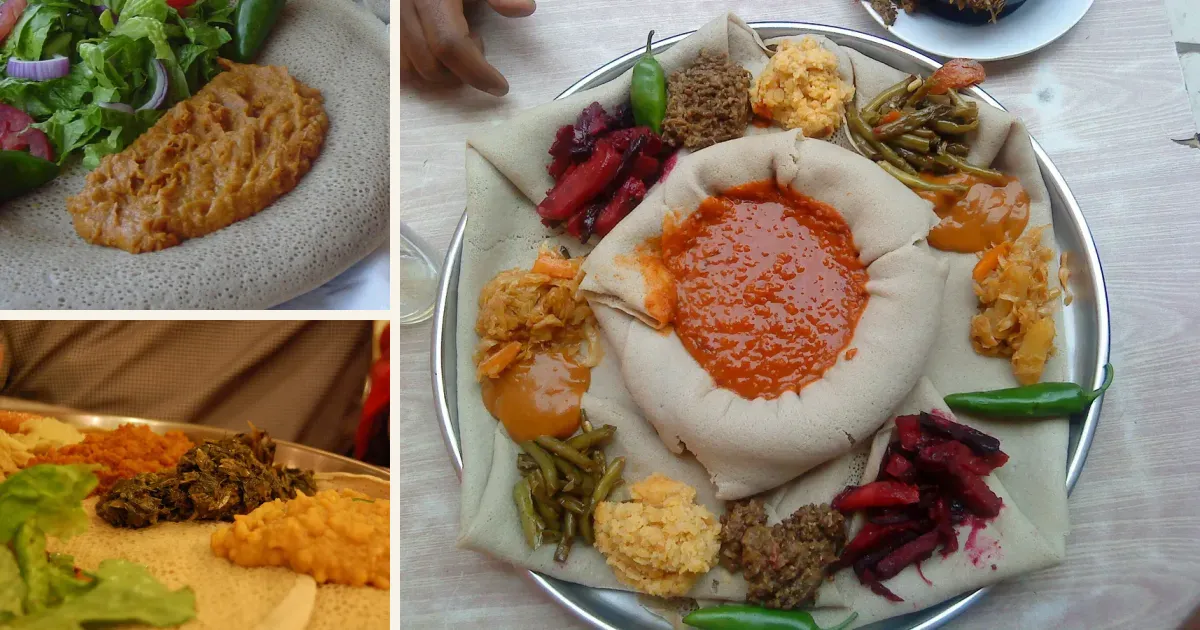
In an Orthodox Ethiopian household, Wednesday and Friday are eaten without animal products. Add Lent, Advent and several shorter fasts, and you reach roughly a hundred and eighty days a year. A whole cuisine grew to meet that rhythm, by calendar rather than by conviction. That is why an Ethiopian restaurant can hand you a complete vegan platter with nothing removed from it.
Fasting as the engine of a cuisine
The Ethiopian fast, called tsom, rules out meat along with eggs and dairy. Cooks therefore learned to pull body and richness out of pulses, oil and spice. The result is a family of dishes known as bayenetu, the fasting platter, where six or seven preparations share one flatbread.
The two dishes to learn first
The most common dish in that repertoire is misir wot, red lentils simmered at length in berbere until they collapse. The second is shiro wat, a flour of roasted chickpeas slaked with water, which gives you a substantial dish in twenty minutes and which many households eat several times a week.
Teff and injera
Injera works as bread, as plate and as cutlery. You lay it on a tray, spoon the preparations over it, and tear off pieces to pick the food up. No fork reaches the table.
It is made from teff, a tiny grain grown on the highlands, whose batter ferments for two to three days. That fermentation produces the sourness and the little craters on the surface that soak up sauce. Teff carries no gluten, so an injera made from pure teff suits coeliacs. Watch the versions sold in Europe though: many cut the teff with wheat or barley flour to lower the cost and make the cooking easier. Read the label if this matters to you.
If you are starting out, assume your first two rounds will fail. The pan wants to be hot and dry, the batter goes in as a spiral from the outside towards the centre, and you never flip an injera.
Berbere and niter kibbeh, the pair that signs the flavour
Two preparations explain most of what you taste in an Ethiopian dish.
| Preparation | What is in it | Role |
|---|---|---|
| Berbere | Dried chilli, fenugreek, ajwain, ginger, black cardamom | Heat, red colour, a bitter floor |
| Niter kibbeh | Clarified butter infused with spice and garlic | Roundness, aroma |
| Mitmita | Bird’s eye chilli, cardamom, salt | Sharp fire, added at the table |
Berbere is more than chilli. Fenugreek gives it a bitterness that builds the dish, and that is the first thing cheap blends drop. Buy yours from an African grocer rather than a supermarket.
For a vegan platter, butter-based niter kibbeh gives way to an oil infused with the same spices. Ethiopian cooks make it that way themselves during the fast, so this is no Western workaround.
Building a platter that holds together
A good bayenetu works on contrast rather than accumulation. The simple rule: for every berbere dish, add a mild one, called alicha, cooked with turmeric and no chilli. Kik alicha, yellow split peas with turmeric and ginger, fills that role and settles the platter between two red mouthfuls.
Contrast rather than quantity
Then bring in vegetables for texture. Atakilt wat cooks cabbage and carrot gently in turmeric, with potato for substance, while gomen keeps a bite in the collard leaves that no pulse purée can give you.
Finish with two cold preparations for freshness. Azifa is a green lentil salad dressed with mustard and lemon, served at room temperature. Timatim mixes tomato and onion with green chilli, sometimes with torn injera soaking in it.
Count on five preparations for four people. They can be made the day before and improve overnight, which makes this an easier meal to host than it looks.
What a beginner gets wrong
Rushing the onion
The first mistake concerns onions. A wat starts with a large amount of sliced onion cooked dry, with no fat at all, for a good ten minutes, until it gives up its water and turns to pulp. Oil or butter arrives only afterwards. Skip that step and the sauce stays thin and never clings.
Cutting the simmer short
The second mistake concerns time. A misir wot wants forty minutes at a low simmer for the berbere to lose its edge. A rushed dish stings without tasting of much, and many people conclude from that, wrongly, that Ethiopian cooking is only about chilli.
Start with shiro wat, which takes half an hour and gives you the taste of berbere at no risk. Misir wot comes next, then injera once you accept losing two rounds to the pan.