Coconut milk, from Kerala to the Caribbean
What coconut milk does in each tropical kitchen, the difference between first and second pressing, and how to stop it splitting.
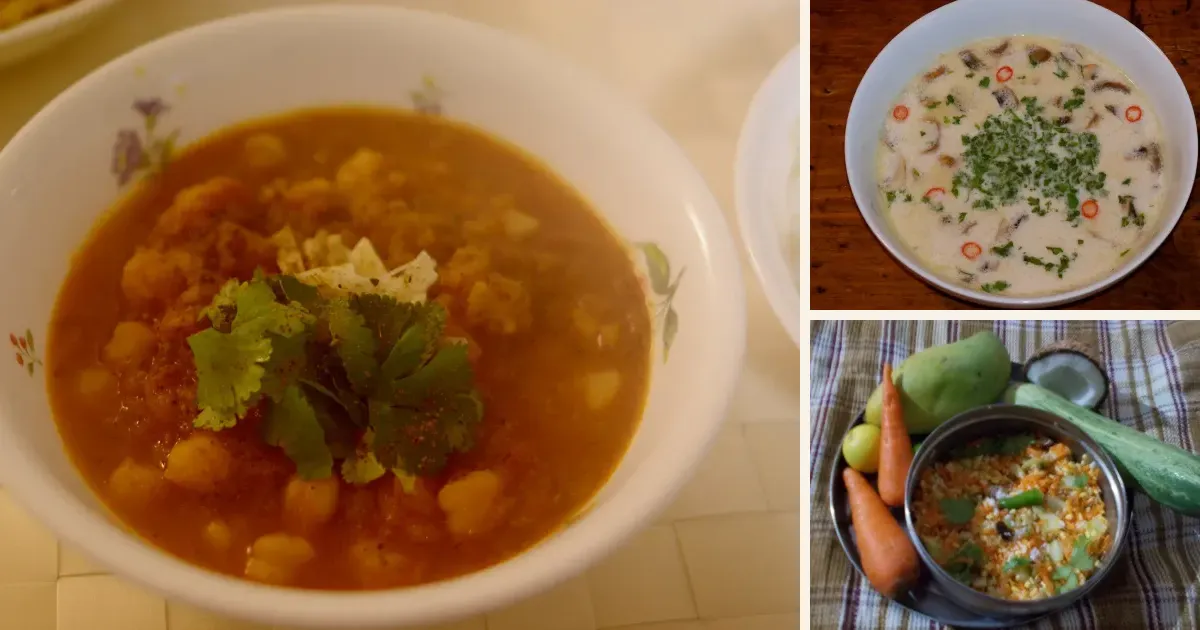
Coconut milk is the fatty base of cooking right across the tropical band, from Kerala to the Caribbean: wherever the coconut palm grows, people have squeezed that milk from the grated flesh of the nut. The tree grows between the tropics, close to the coast. What each kitchen then did with the milk depended on what grew beside it. The same principle, drawing a milk from a plant with water, produced Valencian horchata and Chinese soy milk elsewhere, and our article on plant milks around the world covers them alongside coconut milk.
First and second pressing
Coconut milk is not a liquid sitting inside the nut. You grate the white flesh, press it by hand with a little hot water, and collect a thick, fatty liquid. That is the first pressing, around 20 to 25 per cent fat.
Return the same flesh to water and press again: the second pressing gives a thin liquid, barely creamy. South-East Asian kitchens call the first thick milk and the second thin milk, and they use them at different moments. Thin milk cooks the vegetables, thick milk arrives at the end to bind.
That split survives in a tin: stand the can upright, open it without shaking, and the cream has set on top. Spoon it off to fry a curry paste, then pour in the thin liquid underneath for the cooking.
Carrying heat in South-East Asia
In Thailand you heat the coconut cream on its own until the oil separates, then fry the curry paste in it. The compounds in chilli and lemongrass dissolve in fat, and this step releases them. A plant-based green curry made without that move stays flat, whatever quantity of paste goes in.
Vegetarian tom kha works the other way: the coconut milk settles the lime acidity and the burn of the galangal without erasing either. The broth stays sharp, yet you can drink a whole bowl.
Vegetarian laksa from Malaysia and Singapore takes richness as far as it goes, with a rempah of chilli, shallot and candlenut that thickens the broth before any coconut arrives. In Indonesia, sayur lodeh runs the opposite exercise, a clear vegetable broth where the coconut stays in the background as a base.
Softening spice in Sri Lanka and Réunion
Sri Lankan dhal curry shows coconut milk’s most common job: it coats the chilli particles and lowers the burn without removing the flavour. Capsaicin, the compound behind that burn, barely dissolves in water but dissolves readily in fat, as we explain in our article on chilli peppers in world cooking, from mild to Scotch Bonnet. The red lentils cook first in water with turmeric, and the coconut comes in afterwards, along with curry leaves bloomed in oil.
On Réunion, cari réunionnais follows a creole logic where coconut rounds off a massalé already in place. The island inherited its spice from Indian migration and its coconut from the climate, and the dish carries both.
Enriching rice and stew in the Caribbean
Across the Atlantic, coconut milk’s first job is to feed the starch. Jamaican rice and peas cooks kidney beans and rice in coconut with thyme and a whole Scotch Bonnet, which scents the pot without making it hot as long as it stays intact, and is lifted out before serving. Every grain ends up coated in fat, and the difference from rice boiled in water needs no looking for.
Rastafari ital stew uses it to bind a stew of root vegetables, without refined salt, where coconut supplies the body that meat stock supplies elsewhere.
| Kitchen | Job of the coconut | Moment |
|---|---|---|
| Thailand | Frying the curry paste | At the start |
| Sri Lanka | Softening chilli | After the lentils cook |
| Malaysia | Thickening the broth | Midway |
| Jamaica | Enriching the rice | From the start |
| Indonesia | Light broth base | Midway |
Why it splits, and how to avoid it
Coconut milk is an emulsion held together by proteins. A hard boil breaks those proteins, the oil separates, and you watch curds float to the top.
Splitting is not always a fault. Thai and Indian kitchens force it on purpose at the start, when they want that scented oil. The trouble comes at the end, when the sauce has to stay smooth.
Two rules cover it. Drop the heat as soon as the coconut goes in: a tremble, not a boil. And add acid at the last moment, lime juice or tamarind, off the heat, because acid curdles those proteins as fast as heat does.
Rescuing a split sauce
If the sauce has turned, take the pan off and whisk in a spoon of cold water. The emulsion often comes back. If it does not, serve it anyway: half the kitchens in the region read oil on the surface as the sign of a dish made right.


