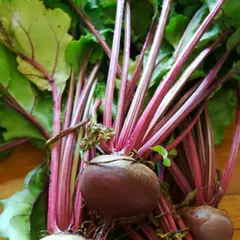
 Recipes with beetroot

Beetroot is the one common vegetable whose colour becomes an ingredient. Its pigment is water-soluble: it runs into the broth, into the cream, onto your hands and the board. You cannot cook it discreetly — the moment it enters a dish, it dyes it. It is also one of the few vegetables that works equally well raw, cooked or pickled, each giving a distinctly different flavour: grated raw it is sharp and earthy; roasted it turns sweet and dense; in vinegar it loses its heaviness.
Eastern European kitchens make it the heart of a broth and play on temperature. Polish barszcz czerwony and Ukrainian borscht cook it long and serve it hot, sharpened with lemon or vinegar; chłodnik goes the other way and serves it ice cold. Elsewhere it is handled as a firm vegetable to be cut up: Russian vinegret dices it among other cooked roots, Danish smørrebrød lays it pickled on the bread, and beetroot hummus blends it with chickpeas as much for the colour as for the sweetness.
The technical point that matters: cook it whole, skin on, with a couple of centimetres of stalk left, and only cut it afterwards. Cut before cooking, it bleeds its colour and sugar into the water and comes out pale and dull. The skin then slips off under cold water with a thumb. A splash of acid at the end revives the red, which drifts towards brown in a dish held too long over heat.
- Recipes on the site
- 6
- Countries represented
- 5
- Ready in 30 minutes or less
- 3
- Vegan
- 4
- Gluten-free
- 4
The best represented countries: Poland (2) · Denmark (1) · Lebanon (1) · Russia (1) · Ukraine (1)
The recipes
 Denmark⏱ 20 min
Vegetarian Smørrebrød
A Danish open sandwich on dense rye, layered with beetroot, quick-pickled cucumber and radish, finished with feathery dill.
 Lebanon⏱ 10 min
Beetroot hummus
Lebanese hummus in bright pink, chickpeas and cooked beetroot blended with tahini, lemon and cumin.
 Poland⏱ 70 min
Barszcz czerwony
A clear, sharp beetroot broth scented with marjoram, served scalding in a cup with small Polish dumplings.
 Poland⏱ 30 min
Chłodnik
A bright pink cold soup of beetroot and kefir, sharpened with dill and lemon, served with a halved boiled egg.
 Russia⏱ 70 min
Vinegret
A Russian salad of beetroot, potato and pickled cucumber cut into small even dice and dressed with sunflower oil.
 Ukraine⏱ 75 min
Vegan borscht
Ruby-red Ukrainian soup of beetroot, cabbage, carrot and potato, sharpened with garlic and vinegar and showered with fresh dill.