Vegetarian recipes from Greece
11 recipes
A guide to the food of Greece
Greek ladera, vegetables cooked down in olive oilWhat the word ladera covers, why these dishes are eaten warm rather than hot, and how they differ from the rest of the meatless Greek repertoire.Greek cooking without meat rests on four plain supports: wheat as bread and filo pastry, dried pulses, olive oil used generously, and a set of aromatics built from onion, dill or parsley and lemon juice. Vegetables are stewed slowly in oil rather than quickly fried, which yields dishes eaten warm or at room temperature, often a day after cooking. Briam shows that slow oven method, courgettes and potatoes softening together; imam bayildi takes it further with aubergine saturated in oil and melted onion, while dolmades wrap rice and herbs in vine leaves.
These dishes form their own category, the fasting cookery followed for several weeks each year and made without animal products. Pulses carry the main weight: fasolada reduces dried beans with carrot, celery and tomato paste, gigantes plaki bakes large beans in a dill and tomato sauce, and revithia simmers chickpeas with onion and lemon. Outside fasting, cheese returns in the filo pies, spanakopita with spinach or tiropita with feta. A meal is assembled by adding small shared plates, with bread and a village salad.
The recipes
 Greece⏱ 150 min
Vegetarian moussaka with lentils
Greek-style vegetarian moussaka: golden potatoes and aubergines, lentils simmered with tomato and cinnamon, and a browned béchamel topping.
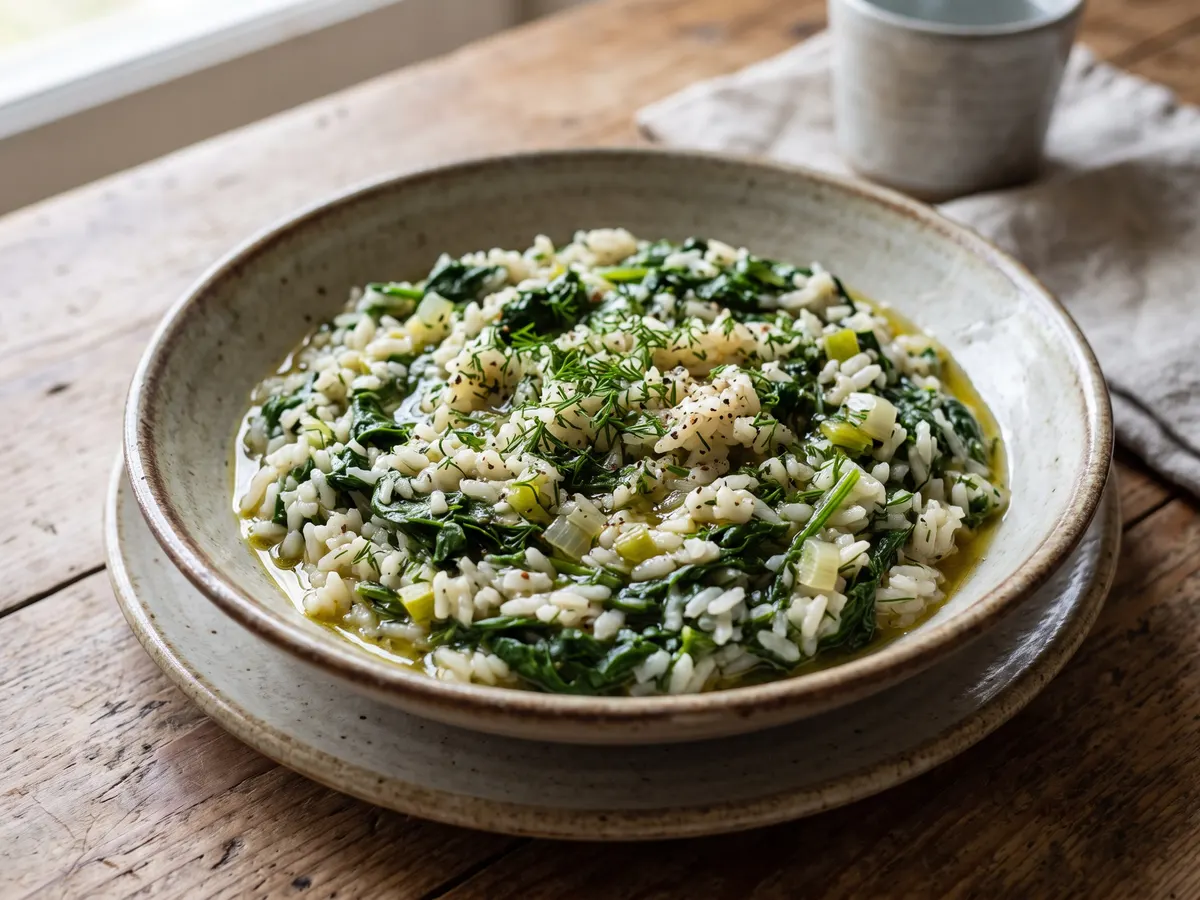 Greece⏱ 40 min
Spanakorizo
The beloved Greek home classic combining tender medium-grain rice with wilted fresh spinach, abundant dill, fragrant olive oil, and bright lemon.
 Greece⏱ 135 min
Revithia
Chickpeas baked slowly with masses of onion, rosemary and lemon, swimming in good Greek olive oil.
 Greece⏱ 115 min
Briam
Thinly sliced summer vegetables slow-roasted in olive oil until sweet, collapsing and caramelised at the edges.
 Greece⏱ 15 min
Horiatiki
Ripe tomatoes, cucumber, green pepper and Kalamata olives under a whole slab of feta and crushed oregano.
 Greece⏱ 70 min
Tiropita
A Greek pie of shatteringly crisp filo wrapped around a soft filling of feta, ricotta and dill.
 Greece⏱ 95 min
Dolmades
Vine leaves rolled around herby rice with dill, mint and pine nuts, gently simmered in olive oil and lemon and served cold.
 Greece⏱ 85 min
Imam bayildi
Whole aubergines stuffed with slow-cooked onions, tomatoes and garlic, then braised in olive oil until meltingly soft and sweet.
 Greece⏱ 105 min
Gigantes plaki
Giant white beans baked in a garlicky onion and tomato sauce until creamy inside and caramelised on top, scattered with fresh dill.
 Greece⏱ 90 min
Fasolada
Greek white bean soup simmered with carrot, celery and tomato, finished with a generous pour of olive oil and a handful of parsley.
 Greece⏱ 75 min
Spanakopita
This spanakopita is the Greek spinach and feta pie, layered between golden, shattering sheets of filo pastry.
At a glance
| Measure | Value |
|---|---|
| Recipes on the site | 11 |
| Of which vegan | 7 |
| Of which gluten-free | 8 |
| Quickest | Horiatiki, 15 min |
These recipes keep coming back to the same few things: lemon, cheese, aubergine, spinach.
Elsewhere in Europe: Italy, France, Spain, Ukraine, Poland, Portugal, Romania, Hungary, Sweden, Denmark, Finland, Russia, Norway.
Read more
- Mediterranean diet: a way of building a plate
What actually defines the Mediterranean diet beyond the folklore, illustrated with real dishes from Greece, Italy, Spain, Lebanon and Morocco.
- The chickpea, from one kitchen to the next
The chickpea’s four states — raw ground, cooked whole, puréed, milled to flour — what each one makes possible, and why a tin cannot stand in for them.
- Pulses, the backbone of the world's kitchens
Which pulse each kitchen chose and why, how to cook them without guessing, and what turns a dry bag into a whole meal.